

ISSN 0439-755X
CN 11-1911/B
CN 11-1911/B
Acta Psychologica Sinica ›› 2026, Vol. 58 ›› Issue (9): 1813-1827.doi: 10.3724/SP.J.1041.2026.1813
• Column on the Stress, Resilience, and Health • Previous Articles Next Articles
LI Hangyu, XU Heng, MU Yurong, YUAN Xiaowei, LI Shouxin, ZHANG Qian( )
)
Received:2025-09-29
Published:2026-09-25
Online:2026-07-29
Contact:
ZHANG Qian, E-mail: qzhang@sdnu.edu.cn
Supported by:LI Hangyu, XU Heng, MU Yurong, YUAN Xiaowei, LI Shouxin, ZHANG Qian. (2026). Moderating role of mental imagery in the relationship between depressive tendency and the filtering efficiency of task-irrelevant emotional stimuli. Acta Psychologica Sinica, 58(9), 1813-1827.
Add to citation manager EndNote|Ris|BibTeX
URL: https://journal.psych.ac.cn/acps/EN/10.3724/SP.J.1041.2026.1813

Figure 1. Examples of facial stimuli with different emotional valences.
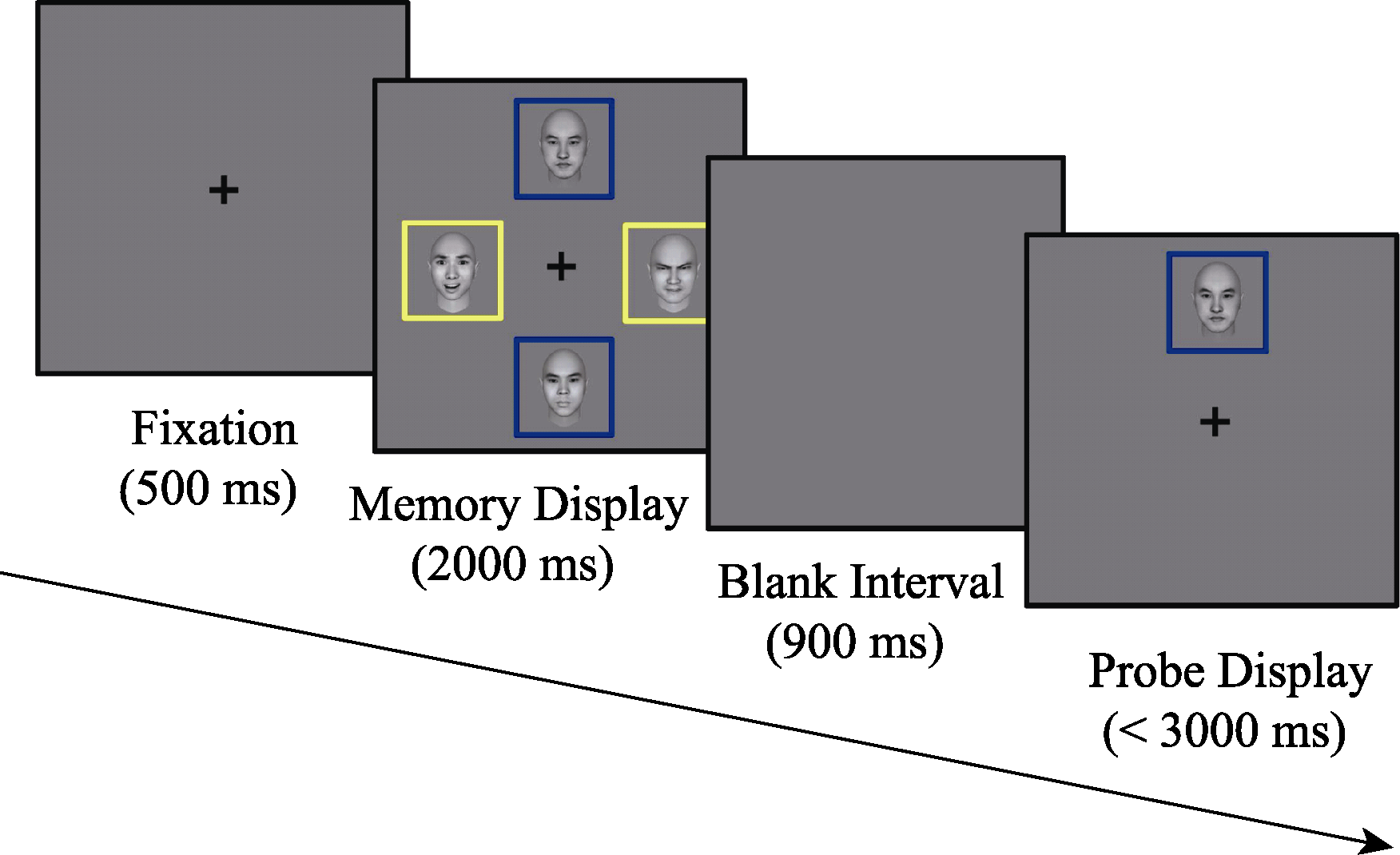
Figure 2. Schematic illustration of a single trial in Study 1. The memory display contained two neutral faces in the blue frame and two negative faces in the yellow frame. Participants remembered the neutral faces and ignored the negative faces. The probed face matched the previously presented face at the same location. For the probe display shown in the example, the correct response was “Yes”.
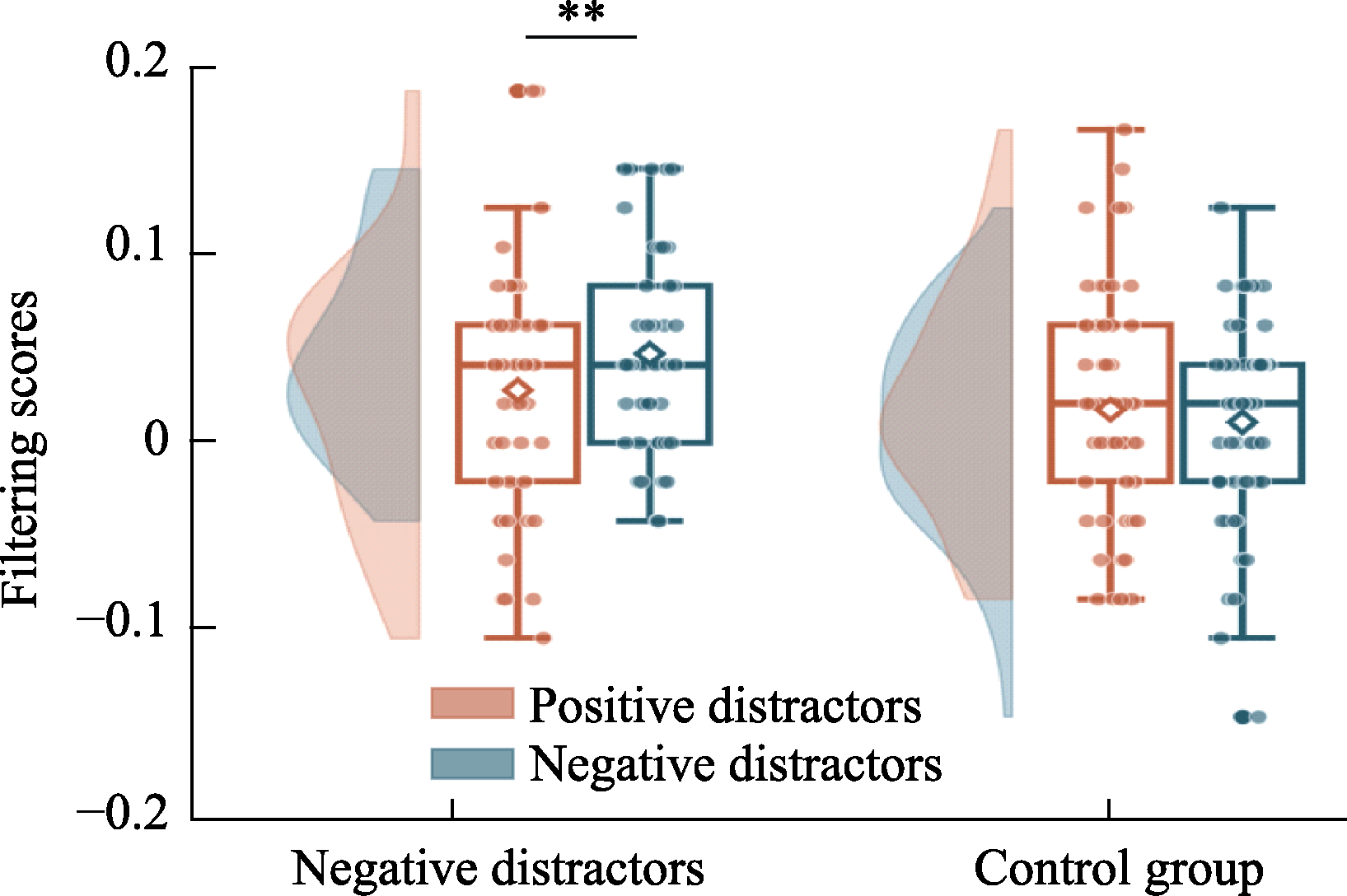
Figure 3. Filtering scores for task-irrelevant positive and negative emotional information across different groups. Note: ** p < 0.01. Half-violin plots represent probability density distributions. Boxes indicate the upper and lower quartiles, with horizontal lines inside the boxes representing the median and diamonds representing the mean. Dots represent raw data points. The same notation applies to the following figures.
| Variable | 1 | 2 | 3 | 4 | 5 | 6 |
|---|---|---|---|---|---|---|
| 1 Depression | 1 | |||||
| 2 State anxiety | 0.510*** | 1 | ||||
| 3 Trait anxiety | 0.578*** | 0.412** | 1 | |||
| 4 Visual imaginary vividness | ?0.206* | ?0.274** | ?0.219* | 1 | ||
| 5 Positive filtering scores | ?0.023 | 0.017 | ?0.063 | ?0.095 | 1 | |
| 6 Negative filtering scores | 0.244* | 0.131 | ?0.013 | ?0.205* | 0.437** | 1 |
Table 1 Correlations among depression, anxiety, visual imagery vividness, and filtering scores (n =104)
| Variable | 1 | 2 | 3 | 4 | 5 | 6 |
|---|---|---|---|---|---|---|
| 1 Depression | 1 | |||||
| 2 State anxiety | 0.510*** | 1 | ||||
| 3 Trait anxiety | 0.578*** | 0.412** | 1 | |||
| 4 Visual imaginary vividness | ?0.206* | ?0.274** | ?0.219* | 1 | ||
| 5 Positive filtering scores | ?0.023 | 0.017 | ?0.063 | ?0.095 | 1 | |
| 6 Negative filtering scores | 0.244* | 0.131 | ?0.013 | ?0.205* | 0.437** | 1 |
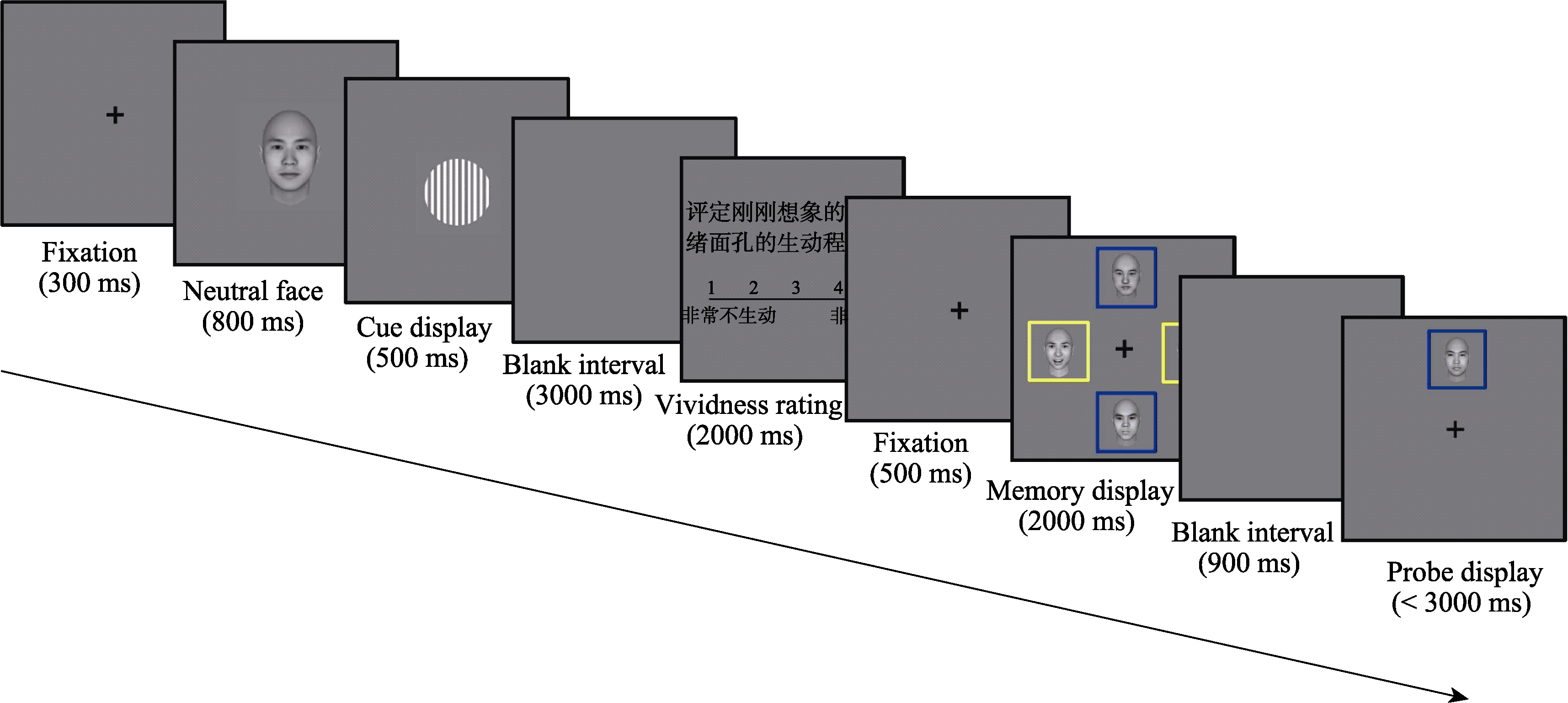
Figure 4. Schematic illustration of the experimental procedure in Study 2. Note. In the illustrated trial, participants first imagined a positive emotional face based on a neutral face cue and then rated the vividness of their mental imagery. They subsequently completed the working memory task, in which neutral faces presented within blue frames served as memory targets and negative faces presented within yellow frames served as distractors. For the probe display shown in the example, the correct response was “No.”
| Study | Condition | Group | Two neutral targets | Two neutral targets + Two negative distractors | Four neutral targets |
|---|---|---|---|---|---|
| Study2 | Positive mental imagery | Depressive tendency | 0.88±0.06 | 0.88±0.06 | 0.74±0.07 |
| Control | 0.92±0.05 | 0.93±0.06 | 0.75±0.09 | ||
| Neutral mental imagery | Depressive tendency | 0.92±0.06 | 0.87±0.07 | 0.72±0.09 | |
| Control | 0.91±0.06 | 0.92±0.06 | 0.72±0.10 | ||
| Study3 | Negative mental imagery | Depressive tendency | 0.90±0.08 | 0.86±0.10 | 0.72±0.10 |
| Control | 0.91±0.09 | 0.84±0.10 | 0.74±0.10 | ||
| Neutral mental imagery | Depressive tendency | 0.89±0.07 | 0.87±0.05 | 0.75±0.09 | |
| Control | 0.87±0.06 | 0.90±0.05 | 0.76±0.10 |
Table 2 Accuracy (M ± SD) on the working memory task in Study2 and Study3
| Study | Condition | Group | Two neutral targets | Two neutral targets + Two negative distractors | Four neutral targets |
|---|---|---|---|---|---|
| Study2 | Positive mental imagery | Depressive tendency | 0.88±0.06 | 0.88±0.06 | 0.74±0.07 |
| Control | 0.92±0.05 | 0.93±0.06 | 0.75±0.09 | ||
| Neutral mental imagery | Depressive tendency | 0.92±0.06 | 0.87±0.07 | 0.72±0.09 | |
| Control | 0.91±0.06 | 0.92±0.06 | 0.72±0.10 | ||
| Study3 | Negative mental imagery | Depressive tendency | 0.90±0.08 | 0.86±0.10 | 0.72±0.10 |
| Control | 0.91±0.09 | 0.84±0.10 | 0.74±0.10 | ||
| Neutral mental imagery | Depressive tendency | 0.89±0.07 | 0.87±0.05 | 0.75±0.09 | |
| Control | 0.87±0.06 | 0.90±0.05 | 0.76±0.10 |
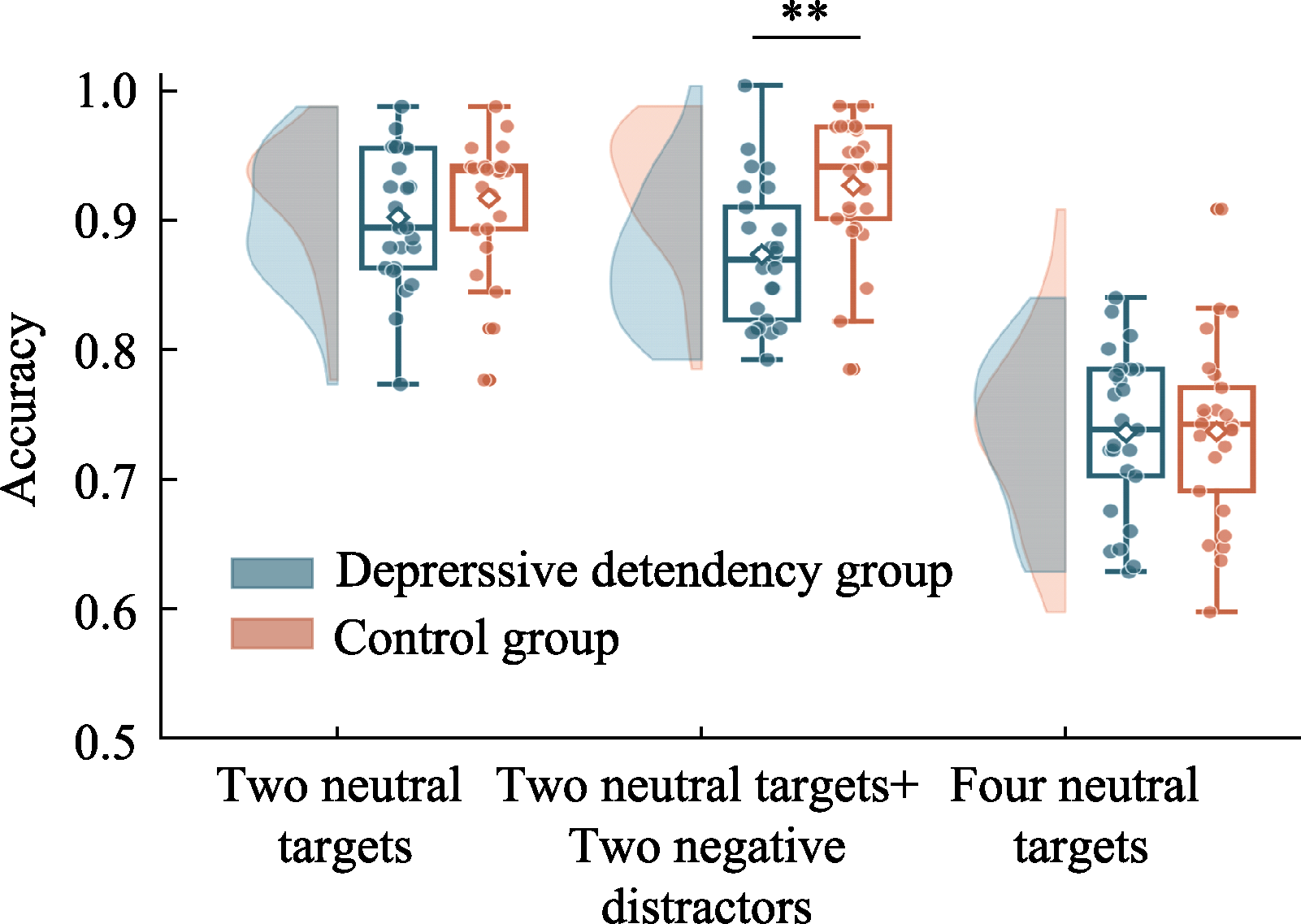
Figure 5. Accuracy in Study 2. Note. ** p < 0.01
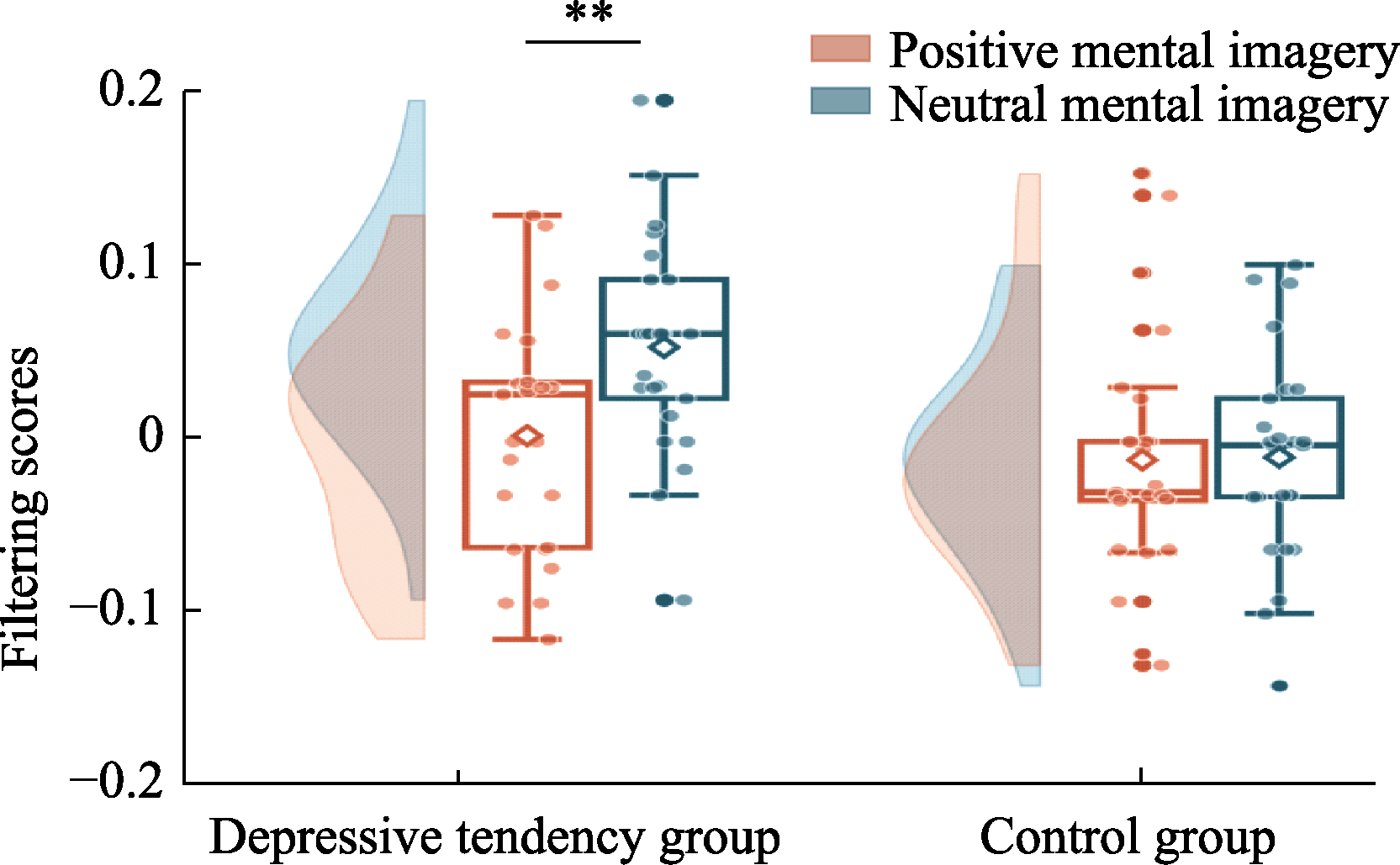
Figure 6. Filtering scores for task-irrelevant negative emotional information across different groups under positive versus neutral mental imagery. Note. ** p < 0.01
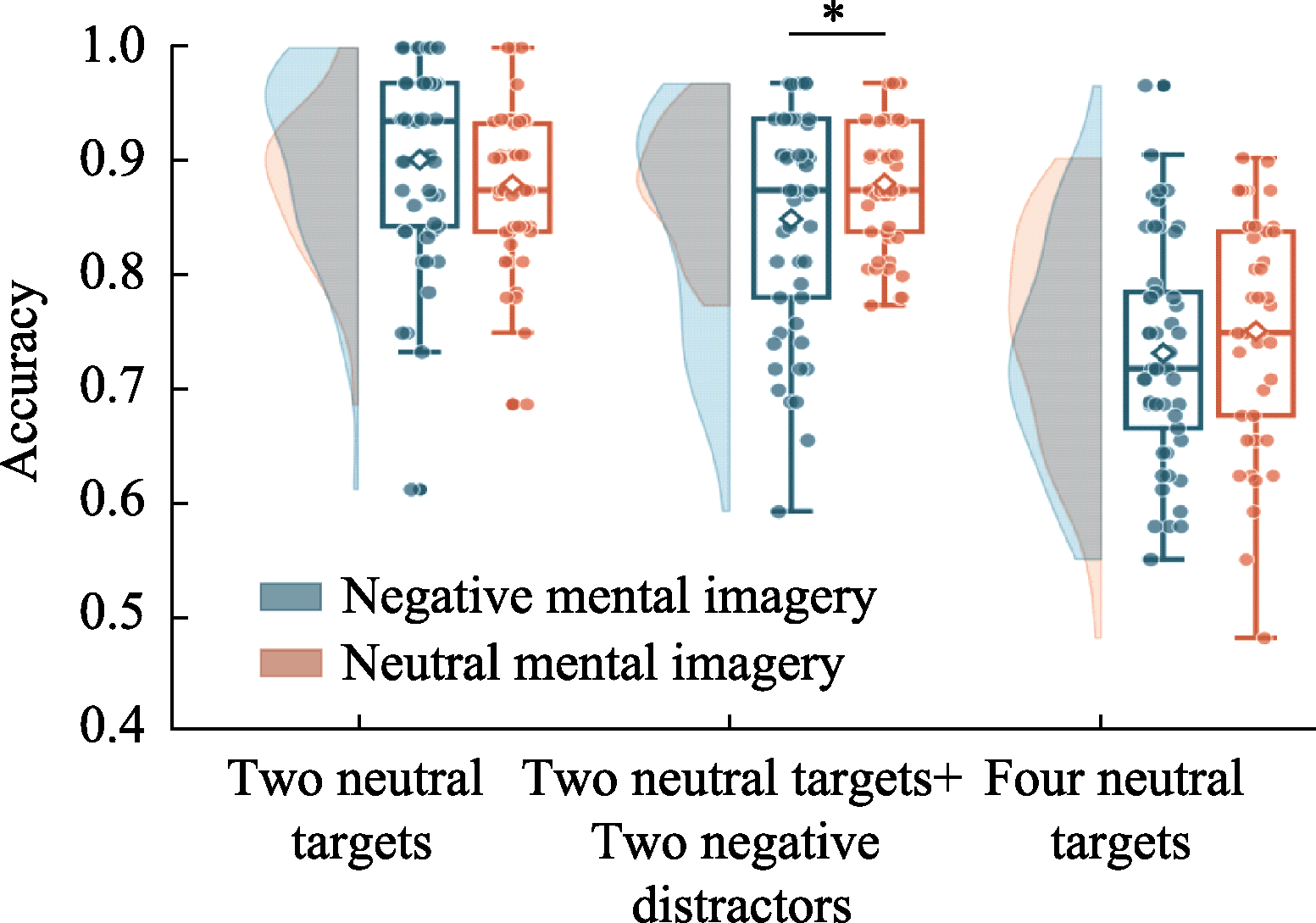
Figure 7. Accuracy in Experiment 3. Note. * p < 0.05
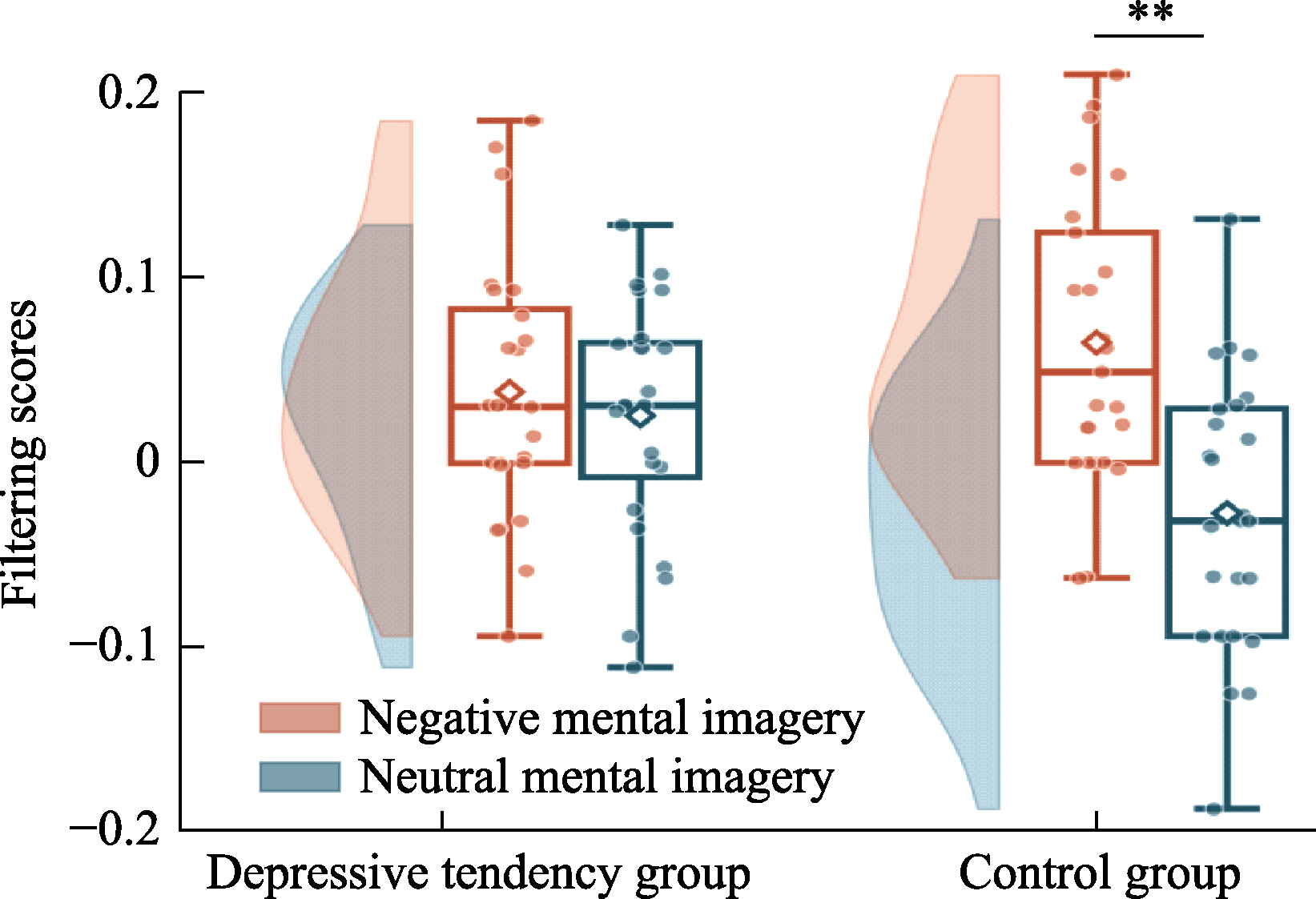
Figure 8. Filtering scores for task-irrelevant negative emotional information across different groups under negative versus neutral mental imagery. Note. ** p < 0.01
| Valence | Awakeness | |
|---|---|---|
| Neutral face 1 | 4.37±0.67 | 3.58±2.36 |
| Neutral face 2 | 4.68±0.58 | 4.05±2.27 |
| Neutral face 3 | 4.89±0.57 | 3.47±2.22 |
| Neutral face 4 | 4.84±1.07 | 3.47±2.04 |
| Neutral face 5 | 5.26±0.87 | 3.84±1.95 |
| Neutral face 6 | 4.89±0.57 | 3.53±1.81 |
| Neutral face 7 | 5.00±0.67 | 3.58±1.98 |
| Neutral face 8 | 4.53±0.70 | 3.84±2.29 |
| Neutral face 9 | 4.74±0.45 | 3.63±2.36 |
| Neutral face 10 | 4.68±0.82 | 3.74±2.13 |
| Neutral face 11 | 4.58±0.96 | 3.53±2.01 |
| Neutral face 12 | 4.89±0.46 | 3.37±2.11 |
Supplementary Table 1. Valence and Arousal scores (M ± SD) for neutral faces
| Valence | Awakeness | |
|---|---|---|
| Neutral face 1 | 4.37±0.67 | 3.58±2.36 |
| Neutral face 2 | 4.68±0.58 | 4.05±2.27 |
| Neutral face 3 | 4.89±0.57 | 3.47±2.22 |
| Neutral face 4 | 4.84±1.07 | 3.47±2.04 |
| Neutral face 5 | 5.26±0.87 | 3.84±1.95 |
| Neutral face 6 | 4.89±0.57 | 3.53±1.81 |
| Neutral face 7 | 5.00±0.67 | 3.58±1.98 |
| Neutral face 8 | 4.53±0.70 | 3.84±2.29 |
| Neutral face 9 | 4.74±0.45 | 3.63±2.36 |
| Neutral face 10 | 4.68±0.82 | 3.74±2.13 |
| Neutral face 11 | 4.58±0.96 | 3.53±2.01 |
| Neutral face 12 | 4.89±0.46 | 3.37±2.11 |
| Valence | Awakeness | |
|---|---|---|
| Positive face 1 | 7.53±1.22 | 6.95±1.68 |
| Positive face 2 | 7.11±1.70 | 7.21±1.58 |
| Positive face 3 | 7.47±1.54 | 7.16±1.71 |
| Positive face 4 | 6.89±1.76 | 7.05±1.81 |
| Positive face 5 | 7.74±1.48 | 7.89±1.15 |
| Positive face 6 | 7.16±1.21 | 6.47±1.71 |
| Positive face 7 | 5.84±1.71 | 5.05±2.22 |
| Positive face 8 | 7.58±0.90 | 6.95±1.54 |
| Positive face 9 | 7.16±1.21 | 6.89±1.52 |
| Positive face 10 | 7.47±1.07 | 7.15±2.06 |
| Positive face 11 | 7.00±0.82 | 6.42±1.92 |
| Positive face 12 | 6.00±0.94 | 5.42±1.92 |
Supplementary Table 2 Valence and Arousal scores (M ± SD) for positive faces
| Valence | Awakeness | |
|---|---|---|
| Positive face 1 | 7.53±1.22 | 6.95±1.68 |
| Positive face 2 | 7.11±1.70 | 7.21±1.58 |
| Positive face 3 | 7.47±1.54 | 7.16±1.71 |
| Positive face 4 | 6.89±1.76 | 7.05±1.81 |
| Positive face 5 | 7.74±1.48 | 7.89±1.15 |
| Positive face 6 | 7.16±1.21 | 6.47±1.71 |
| Positive face 7 | 5.84±1.71 | 5.05±2.22 |
| Positive face 8 | 7.58±0.90 | 6.95±1.54 |
| Positive face 9 | 7.16±1.21 | 6.89±1.52 |
| Positive face 10 | 7.47±1.07 | 7.15±2.06 |
| Positive face 11 | 7.00±0.82 | 6.42±1.92 |
| Positive face 12 | 6.00±0.94 | 5.42±1.92 |
| Valence | Awakeness | |
|---|---|---|
| Negative face 1 | 2.53±0.70 | 6.68±1.53 |
| Negative face 2 | 2.21±0.71 | 7.11±2.05 |
| Negative face 3 | 2.16±0.96 | 7.00±1.60 |
| Negative face 4 | 2.84±1.07 | 6.21±1.84 |
| Negative face 5 | 3.00±1.24 | 6.63±1.98 |
| Negative face 6 | 2.63±0.83 | 6.95±1.47 |
| Negative face 7 | 1.58±0.61 | 7.32±1.95 |
| Negative face 8 | 1.47±0.84 | 7.95±1.31 |
| Negative face 9 | 2.16±0.76 | 7.37±1.34 |
| Negative face 10 | 2.63±1.42 | 6.63±1.89 |
| Negative face 11 | 2.05±0.85 | 7.32±1.38 |
| Negative face 12 | 2.95±1.72 | 6.47±1.87 |
Supplementary Table 3 Valence and Arousal scores (M ± SD) for negative faces
| Valence | Awakeness | |
|---|---|---|
| Negative face 1 | 2.53±0.70 | 6.68±1.53 |
| Negative face 2 | 2.21±0.71 | 7.11±2.05 |
| Negative face 3 | 2.16±0.96 | 7.00±1.60 |
| Negative face 4 | 2.84±1.07 | 6.21±1.84 |
| Negative face 5 | 3.00±1.24 | 6.63±1.98 |
| Negative face 6 | 2.63±0.83 | 6.95±1.47 |
| Negative face 7 | 1.58±0.61 | 7.32±1.95 |
| Negative face 8 | 1.47±0.84 | 7.95±1.31 |
| Negative face 9 | 2.16±0.76 | 7.37±1.34 |
| Negative face 10 | 2.63±1.42 | 6.63±1.89 |
| Negative face 11 | 2.05±0.85 | 7.32±1.38 |
| Negative face 12 | 2.95±1.72 | 6.47±1.87 |
| [1] |
Bär H. E., Werthmann J., Paetsch A., & Renner F. (2023). The traces of imagination: Early attention bias toward positively imagined stimuli. Psychological Research, 87(5), 1475-1483.
doi: 10.1007/s00426-022-01737-0 |
| [2] |
Dai Q., & Feng Z. (2011). Deficient interference inhibition for negative stimuli in depression: An event-related potential study. Clinical Neurophysiology, 122(1), 52-61.
doi: 10.1016/j.clinph.2010.05.025 pmid: 20605107 |
| [3] |
Downing P., & Dodds C. (2004). Competition in visual working memory for control of search. Visual Cognition, 11(6), 689-703.
doi: 10.1080/13506280344000446 URL |
| [4] |
Faul F., Erdfelder E., Lang A. G., & Buchner A. (2007). G* Power 3: A flexible statistical power analysis program for the social, behavioral, and biomedical sciences. Behavior Research Methods, 39(2), 175-191.
doi: 10.3758/BF03193146 URL |
| [5] | Fuggetta G., Duke P. A., Chakraborty R., Murugesan P., Cocciarelli J., & Delibashi E. (2025). The impact of state depression on proactive control and distractor processing in a memory task: An electrophysiological study. Applied Sciences, 15(6), 3069. |
| [6] |
Görgen S. M., Joormann J., Hiller W., & Witthöft M. (2015). The role of mental imagery in depression: Negative mental imagery induces strong implicit and explicit affect in depression. Frontiers in Psychiatry, 6, 94.
doi: 10.3389/fpsyt.2015.00094 pmid: 26217240 |
| [7] |
Grol M., Vingerhoets G., & De Raedt R. (2017). Mental imagery of positive and neutral memories: A fMRI study comparing field perspective imagery to observer perspective imagery. Brain and Cognition, 111, 13-24.
doi: S0278-2626(16)30279-2 pmid: 27816776 |
| [8] | Hadar B., Luria R., & Liberman N. (2020). Induced social power improves visual working memory. Personality & Social Psychology Bulletin, 46(2), 285-297. |
| [9] | Hasher L., & Zacks R. T. (1988). Working memory, comprehension, and aging: A review and a new view. Psychology of Learning and Motivation, 22, 193-225. |
| [10] |
Holmes E. A., Lang T.J., & Deeprose C. (2009). Mental imagery and emotion in treatment across disorders: Using the example of depression. Cognitive Behaviour Therapy, 38(1), 21-28.
doi: 10.1080/16506070902980729 URL |
| [11] |
Huang Z., & Li X. (2021). Processing of emotional information in working memory in major depressive disorder. Advances in Psychological Science, 29(2), 252-267.
doi: 10.3724/SP.J.1042.2021.00252 |
| [12] |
Itoh M., Hori H., Lin M., Niwa M., Ino K., Imai R., … Kim Y. (2019). Memory bias and its association with memory function in women with posttraumatic stress disorder. Journal of Affective Disorders, 245, 461-467.
doi: S0165-0327(18)31193-5 pmid: 30428446 |
| [13] |
Jermann F., Van der Linden M., Laurençon M., & Schmitt B. (2009). Recollective experience during recognition of emotional words in clinical depression. Journal of Psychopathology and Behavioral Assessment, 31(1), 27-35.
doi: 10.1007/s10862-008-9093-1 URL |
| [14] |
Ji J. L., Murphy F. C., Grafton B., MacLeod C., & Holmes E. A. (2022). Emotional mental imagery generation during spontaneous future thinking: Relationship with optimism and negative mood. Psychological Research, 86(2), 617-626.
doi: 10.1007/s00426-021-01501-w |
| [15] |
Joormann J., & Gotlib I. H. (2007). Selective attention to emotional faces following recovery from depression. Journal of Abnormal Psychology, 116(1), 80-85.
doi: 10.1037/0021-843X.116.1.80 pmid: 17324018 |
| [16] |
Levens S. M., & Gotlib I. H. (2010). Updating positive and negative stimuli in working memory in depression. Journal of Experimental Psychology: General, 139(4), 654-664.
doi: 10.1037/a0020283 URL |
| [17] |
Lewinsohn P. M., Solomon A., Seeley J. R., & Zeiss A. (2000). Clinical implications of “subthreshold” depressive symptoms. Journal of Abnormal Psychology, 109(2), 345-351.
pmid: 10895574 |
| [18] |
Li M., Feng L., Liu X., Zhang M., Fu B., Wang G., & Hu B. (2018). Emotional working memory in patients with major depressive disorder. Journal of International Medical Research, 46(5), 1734-1746.
doi: 10.1177/0300060518758225 pmid: 29529905 |
| [19] |
Li X., Chen X. L., Zhang Y. T., Li R. T., Bai H. P., Lui S. S., & Chan R. C. (2021). Deficits in maintenance and interference control of working memory in major depression: Evidence from the visuospatial change detection task. Cognitive Neuropsychiatry, 26(2), 122-135.
doi: 10.1080/13546805.2021.1871890 pmid: 33412994 |
| [20] |
Luck S. J., & Vogel E. K. (1997). The capacity of visual working memory for features and conjunctions. Nature, 390(6657), 279-281.
doi: 10.1038/36846 |
| [21] |
Marks D. F. (1973). Visual imagery differences in the recall of pictures. British Journal of Psychology, 64(1), 17-24.
pmid: 4742442 |
| [22] | MacNamara A. (2018). In the mind’s eye: The late positive potential to negative and neutral mental imagery and intolerance of uncertainty. Psychophysiology, 55(5), e13024. |
| [23] |
Mayer J. D., Gayle M., Meehan M. E., & Haarman A. K. (1990). Toward better specification of the mood-congruency effect in recall. Journal of Experimental Social Psychology, 26(6), 465-480.
doi: 10.1016/0022-1031(90)90051-M URL |
| [24] | Mechera-Ostrovsky T., & Gluth S. (2018). Memory beliefs drive the memory bias on value-based decisions. Scientific Reports, 8(1), 10592. |
| [25] |
Morina N., Deeprose C., Pusowski C., Schmid M., & Holmes E. A. (2011). Prospective mental imagery in patients with major depressive disorder or anxiety disorders. Journal of Anxiety Disorders, 25(8), 1032-1037.
doi: 10.1016/j.janxdis.2011.06.012 pmid: 21783339 |
| [26] |
Moriya J. (2018). Visual mental imagery influences attentional guidance in a visual search task. Attention, Perception, & Psychophysics, 80(5), 1127-1142.
doi: 10.3758/s13414-018-1520-0 |
| [27] |
Öhman A. (2005). The role of the amygdala in human fear: Automatic detection of threat. Psychoneuroendocrinology, 30(10), 953-958.
doi: 10.1016/j.psyneuen.2005.03.019 pmid: 15963650 |
| [28] |
Owens M., Koster E. H. W., & Derakshan N. (2012). Impaired filtering of irrelevant information in dysphoria: An ERP study. Social Cognitive and Affective Neuroscience, 7(7), 752-763.
doi: 10.1093/scan/nsr050 pmid: 21896495 |
| [29] |
Pearson J. (2019). The human imagination: The cognitive neuroscience of visual mental imagery. Nature Reviews Neuroscience, 20(10), 624-634.
doi: 10.1038/s41583-019-0202-9 pmid: 31384033 |
| [30] |
Peng W., Luo W., & Zhou R. (2019). HRV evidence for the improvement of emotion regulation in university students with depression tendency by working memory training. Acta Psychologica Sinica, 51(6), 648-661.
doi: 10.3724/SP.J.1041.2019.00648 |
| [31] |
Poncet M., Spotorno S., & Jackson M. C. (2025). Competition between emotional faces in visuospatial working memory. Journal of Experimental Psychology: Learning, Memory, and Cognition, 51(1), 68-81.
doi: 10.1037/xlm0001330 URL |
| [32] |
Pratto F., & John O. P. (1991). Automatic vigilance: The attention-grabbing power of negative social information. Journal of Personality and Social Psychology, 61(3), 380-391.
pmid: 1941510 |
| [33] |
Radloff L. S. (1977). The CES-D scale: A self-report depression scale for research in the general population. Applied Psychological Measurement, 1(3), 385-401.
doi: 10.1177/014662167700100306 URL |
| [34] |
Renner F., Ji J. L., Pictet A., Holmes E. A., & Blackwell S. E. (2017). Effects of engaging in repeated mental imagery of future positive events on behavioural activation in individuals with major depressive disorder. Cognitive Therapy and Research, 41(3), 369-380.
doi: 10.1007/s10608-016-9776-y pmid: 28515538 |
| [35] |
Rock P. L., Roiser J. P., Riedel W. J., & Blackwell A. D. (2014). Cognitive impairment in depression: A systematic review and meta-analysis. Psychological Medicine, 44(10), 2029-2040.
doi: 10.1017/S0033291713002535 pmid: 24168753 |
| [36] |
Schacter D. L., Addis D. R., & Buckner R. L. (2007). Remembering the past to imagine the future: The prospective brain. Nature Reviews Neuroscience, 8(9), 657-661.
doi: 10.1038/nrn2213 pmid: 17700624 |
| [37] |
Schendan H. E., & Ganis G. (2012). Electrophysiological potentials reveal cortical mechanisms for mental imagery, mental simulation, and grounded (embodied) cognition. Frontiers in Psychology, 3, 329.
doi: 10.3389/fpsyg.2012.00329 pmid: 23049515 |
| [38] |
Song Y., Liu Z., Chen H., Guo Q., & Huang Y. (2020). Incidence and risk factors of depressive symptoms in Chinese college students. Neuropsychiatric Disease and Treatment, 16, 2449-2457.
doi: 10.2147/NDT.S264775 pmid: 33122908 |
| [39] | Spielberger C. D., Gonzalez-Reigosa F., Martinez-Urrutia A., Natalicio L. F., & Natalicio D. S. (1971). Development of the Spanish edition of the State-Trait Anxiety Inventory. Interamerican Journal of Psychology, 5(3-4), 145-158. |
| [40] |
Stout D. M., Shackman A. J., Johnson J. S., & Larson C. L. (2015). Worry is associated with impaired gating of threat from working memory. Emotion, 15(1), 6-11.
doi: 10.1037/emo0000015 pmid: 25151519 |
| [41] |
Torkan H., Blackwell S. E., Holmes E. A., Kalantari M., Neshat-Doost H. T., Maroufi M., & Talebi H. (2014). Positive imagery cognitive bias modification in treatment-seeking patients with major depression in Iran: A pilot study. Cognitive Therapy and Research, 38(2), 132-145.
doi: 10.1007/s10608-014-9598-8 URL |
| [42] |
Tuithof M., Ten Have M., van Dorsselaer S., Kleinjan M., Beekman A., & de Graaf R. (2018). Course of subthreshold depression into a depressive disorder and its risk factors. Journal of Affective Disorders, 241, 206-215.
doi: S0165-0327(18)30657-8 pmid: 30130686 |
| [43] |
Vogel E. K., McCollough A. W., & Machizawa M. G. (2005). Neural measures reveal individual differences in controlling access to working memory. Nature, 438(7067), 500-503.
doi: 10.1038/nature04171 |
| [44] | Wang X., Wang X., & Ma H. (1999). Assessment inventory handbook of mental health. Beijing, Chinese Mental Health Journal. |
| [45] | Wang Y., & Luo Y. (2005). Standardization and assessment of college students’ facial expression of emotion. Chinese Journal of Clinical Psychology, 13(4), 396-398. |
| [46] | Weßlau C., Cloos M., Höfling V., & Steil R. (2015). Visual mental imagery and symptoms of depression-Results from a large-scale web-based study. BMC Psychiatry, 15(1), 308. |
| [47] |
Wen A., Fischer E. R., Watson D., & Yoon K. L. (2023). Biased cognitive control of emotional information in remitted depression: A meta-analytic review. Journal of Psychopathology and Clinical Science, 132(8), 921-936.
doi: 10.1037/abn0000848 URL |
| [48] |
Wilson A. C., Schwannauer M., McLaughlin A., Ashworth F., & Chan S. W. (2018). Vividness of positive mental imagery predicts positive emotional response to visually presented Project Soothe pictures. British Journal of Psychology, 109(2), 259-276.
doi: 10.1111/bjop.12267 pmid: 28940324 |
| [49] |
Xu T., Zhou Y., & Wang Y. (2025). Effects of mindful breathing exercise on attention bias in Chinese college students with sub-threshold depression. Mindfulness, 16(5), 1216-1229.
doi: 10.1007/s12671-025-02552-5 |
| [50] | Ye C., Liu R., Guo L., Zhao G., & Liu Q. (2024). A negative emotional state impairs individuals’ ability to filter distractors from working memory: An ERP study. Cognitive, Affective, & Behavioral Neuroscience, 24(3), 491-504. |
| [51] |
Ye C., Xu Q., Liu Q., Cong F., Saariluoma P., Ristaniemi T., & Astikainen P. (2018). The impact of visual working memory capacity on the filtering efficiency of emotional face distractors. Biological Psychology, 138, 63-72.
doi: S0301-0511(18)30588-X pmid: 30125615 |
| [52] |
Zhang S., Wang L., & Jiang Y. (2025). Visual mental imagery of nonpredictive central social cues triggers automatic attentional orienting. Cognition, 254, 105968.
doi: 10.1016/j.cognition.2024.105968 URL |
| [53] |
Zhang Z., Zhang L., & Gong R. (2021). The filtering efficiency in visual working memory. Advances in Psychological Science, 29(4), 635-651.
doi: 10.3724/SP.J.1042.2021.00635 |
| [1] | GAO Yuanxia, WANG Jiangyang. Effects of reward and punishment motivation on working memory updating among college students at high risk for internet gaming disorder [J]. Acta Psychologica Sinica, 2026, 58(8): 1517-1531. |
| [2] | GUO Ruiqiao, LI Wenrui, GUO Xue, ZHAO Na, LEI Ming, LIU Qiang. The impact of tACS stimulation timing on the modulation of working memory [J]. Acta Psychologica Sinica, 2026, 58(5): 827-839. |
| [3] | SONG Yi, FU Xiaotong, YUAN Jiajin, SUN Meng, YANG Jiemin. Buildup of a self-compassion sentence collection in the construct of implementation intention and its application in emotion regulation [J]. Acta Psychologica Sinica, 2026, 58(3): 480-499. |
| [4] | LIAN Haomin, ZHANG Qian, GU Xuemin, LI Shouxin. Influence of Sustained Visual Attention on the Prioritization of Visual Working Memory [J]. Acta Psychologica Sinica, 2025, 57(2): 191-206. |
| [5] | ZHOU Linshu, ZHANG Yuqing, CAI Dan-Chao. Musical training enhances the interaction between pitch and time dimensions in auditory working memory [J]. Acta Psychologica Sinica, 2025, 57(10): 1701-1714. |
| [6] | LI Ziyuan, LEI Ming, LIU Qiang. Cognitive mechanisms underlying the formation of offline representations in visual working memory [J]. Acta Psychologica Sinica, 2024, 56(4): 412-420. |
| [7] | PANG Chao, CHEN Yanzhang, WANG Li, YANG Xiduan, HE Ya, LI Zhiying, OUYANG Xiaoyu, FU Shimin, NAN Weizhi. Different attentional selection modes of object information in the encoding and maintenance stages of visual working memory [J]. Acta Psychologica Sinica, 2023, 55(9): 1397-1410. |
| [8] | DONG Tiantian, XU Lulu, HE Wen. Is positivity always beneficial? The effect of positive meta-stereotypes on working memory and their mechanism [J]. Acta Psychologica Sinica, 2023, 55(8): 1344-1357. |
| [9] | CHEN Yueyuan, FANG Weining, GUO Beiyuan, BAO Haifeng. Effects of interruption on work performance and the moderating effects of mental fatigue [J]. Acta Psychologica Sinica, 2023, 55(1): 22-35. |
| [10] | WANG Qiangqiang, ZHANG Qi, SHI Wendian, WANG Zhiwei, ZHANG Pengcheng. Online construction of spatial representation of numbers: Evidence from the SNARC effect in number processing in interferential situations [J]. Acta Psychologica Sinica, 2022, 54(7): 761-771. |
| [11] | JIA Shiwei, QI Congcong, CHEN Lele, REN Yanju. The effect of working memory load on feedback processing: Evidence from an event-related potentials (ERP) study [J]. Acta Psychologica Sinica, 2022, 54(3): 248-258. |
| [12] | WANG Ming, SUN Qiwu, LIU Jing, REN Zhihong, JIANG Guangrong. Effects of vulnerable personality traits of PTSD, working memory abilities and peritraumatic cognitive processing on analogue traumatic flashbacks [J]. Acta Psychologica Sinica, 2022, 54(2): 168-181. |
| [13] | CHE Xiaowei, XU Huiyun, WANG Kaixuan, ZHANG Qian, LI Shouxin. Precision requirement of working memory representations influences attentional guidance [J]. Acta Psychologica Sinica, 2021, 53(7): 694-713. |
| [14] | SUN Yanliang, SONG Jiaru, XIN Xiaowen, DING Xiaowei, LI Shouxin. Same-category advantage on the capacity of visual working memory [J]. Acta Psychologica Sinica, 2021, 53(11): 1189-1202. |
| [15] | HUANG Yuesheng, ZHANG Bao, FAN Xinhua, HUANG Jie. Can negative emotion of task-irrelevant working memory representation affect its attentional capture? A study of eye movements [J]. Acta Psychologica Sinica, 2021, 53(1): 26-37. |
| Viewed | ||||||
|
Full text |
|
|||||
|
Abstract |
|
|||||
